2026 Top Educational Toys for STEM Education How They Help?

Time:2026-09-14 Author:Isabella
0%

The 2026 Top Educational Toys for STEM Education guide examines how play can become purposeful learning. It explores how educational toys help with stem education through building, testing, coding, measuring, and redesigning. A child may connect a small motor to a battery, watch a wheel turn, and then ask why it stops. That moment matters.

Dr. Mitchel Resnick, LEGO Papert Professor of Learning Research at MIT, has studied creative learning for decades. He said, “The role of the teacher is to create the conditions for invention rather than provide ready-made knowledge.” His view supports hands-on toys that let children make choices instead of following only fixed instructions. Construction sets can develop spatial reasoning. Coding robots can introduce sequencing and debugging. Science kits can make invisible ideas visible through simple experiments.

Still, a colorful box does not guarantee STEM learning. It can become unused clutter. Adult guidance, age suitability, open-ended challenges, and safe materials influence the experience. The best toys invite children to predict, build, fail, and try again. Some products may also overpromise their educational value. That deserves honest attention. This guide compares leading 2026 options through practical features, learning goals, durability, accessibility, and real-world play potential. Parents and educators will find clearer ways to choose toys that support curiosity rather than merely fill a shelf.
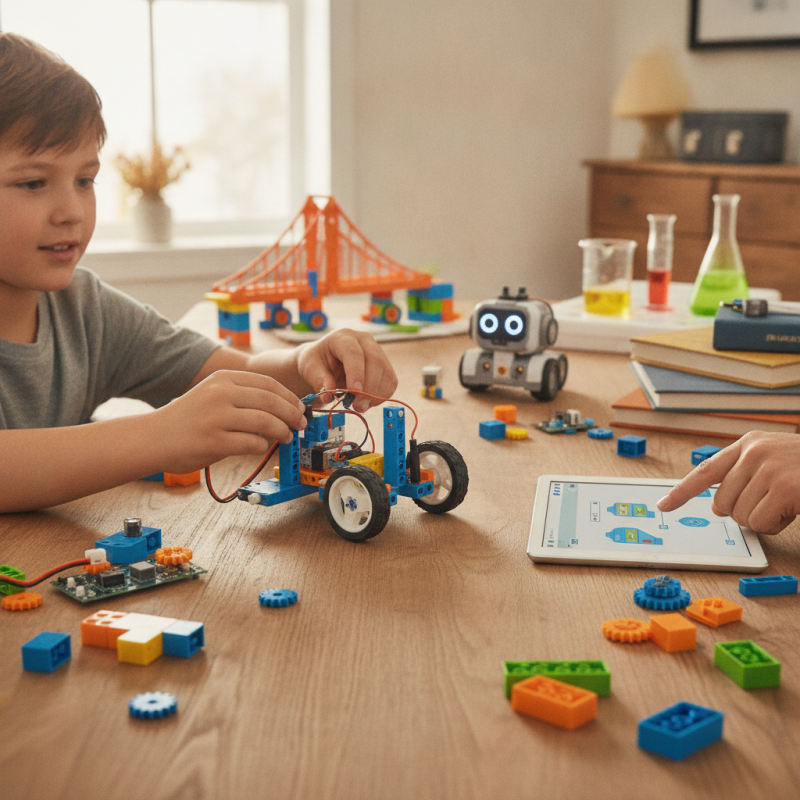
2026 Top Educational Toys for STEM Education How They Help?

What Are STEM Educational Toys and Why Do They Matter in 2026?

STEM educational toys are hands-on tools that connect science, technology, engineering, and mathematics with everyday play. In 2026, they include coding boards, building systems, circuit sets, measuring tools, and simple robotics kits. Children can test an idea, observe a result, and change one part at a time. This turns abstract lessons into visible experiences, such as a motor spinning after a circuit closes.

They matter because active practice strengthens problem-solving, spatial reasoning, and persistence. A child may build a bridge from six pieces, place a small weight on it, and watch it bend. That failure creates a useful question: what should change? Teachers can guide the process with evidence-based questions instead of giving immediate answers. Parents can also notice whether a toy encourages independent thinking or only repeats instructions.

Good STEM toys should match a child’s age, abilities, and interests. They need clear safety guidance, durable parts, and instructions that support exploration. Privacy matters when connected toys collect information, so adults should check settings and data policies carefully. Not every expensive toy produces deep learning. Some children prefer cardboard, magnets, or recycled materials. That is worth remembering. A classroom trial may reveal that a simple gear activity creates more discussion than a complicated electronic kit. Adults should observe the child’s questions, mistakes, and design choices, then adjust the challenge. Progress is often messy. That is part of the learning.

Which Skills Do Top STEM Toys Help Children Develop?

Top Educational Toys for STEM Education in 2026: Which Skills Do They Help Children Develop?

A strong STEM toy gives children something to test, change, and explain. Building sets develop spatial reasoning through balance, measurement, and rotation. Coding toys strengthen sequencing, pattern recognition, and early computational thinking. Science kits make cause and effect visible. One variable changes, and the result shifts. In my experience, learning improves when children predict before touching the materials. That pause matters. It turns play into evidence-based reasoning.

The World Economic Forum’s Future of Jobs Report 2025 surveyed more than 1,000 employers representing 14 million workers. Analytical thinking ranked as the most requested core skill, identified by 69% of employers. Creative thinking followed at 57%. Open-ended STEM toys support both skills because children can design, fail, revise, and defend their choices. OECD PISA 2022 assessed creative thinking across 64 countries and economies. Its framework emphasized generating, evaluating, and improving ideas. Toys with several possible solutions fit this approach better than one-answer puzzles.

Team-based challenges also build communication and persistence. Children must explain why a bridge collapsed or why a robot stopped. However, a toy is not automatically educational. Some activities become button pressing with bright packaging. Adults can also over-direct every step. A better approach leaves room for mistakes, quiet observation, and questions without immediate answers.

How Do STEM Toys Support Learning Through Play?

How Do STEM Toys Support Learning Through Play?

STEM toys turn abstract ideas into actions children can see and touch. A child testing a marble track notices gravity, speed, and failed designs. Another child sorting magnetic tiles practices geometry while building a bridge. Play makes questions feel natural, not like examination tasks. The UNICEF Learning through Play guidance links play with cognitive, social, emotional, and physical development. These benefits depend on active participation, however. A toy cannot replace conversation, guidance, or patient experimentation.

The World Economic Forum’s Future of Jobs Report 2025 identifies analytical thinking as a leading workplace skill. It also reports that 59 out of 100 workers may need training before 2030. STEM toys offer early practice with planning, testing, and revising. Open-ended kits work especially well because children can create several solutions. Digital tools may add simulations, but the UNESCO Global Education Monitoring Report 2023 warns that technology can distract when learning goals are unclear. That warning matters at home. A screen showing a perfect answer may reduce useful struggle. Sometimes, the better lesson is a crooked paper tower collapsing on the floor. Adults should ask, “What could change?” instead of fixing everything. Evidence supports play-based learning, but results vary with age, access, language, and adult support. I would not call every brightly packaged puzzle educational. Observe the child’s thinking, not only the finished object.

2026 Top Educational Toys for STEM Education How They Help? - How Do STEM Toys Support Learning Through Play?

STEM Toy Category Typical Age Primary STEM Skills How Learning Happens Through Play Learning Outcomes Best Learning Setting Adult Support
Construction and Building Sets 3–12 years Spatial reasoning Balance Engineering design Children build towers, bridges, vehicles, and other structures, then adjust designs when parts do not fit or remain stable. Improves planning, fine-motor coordination, persistence, and understanding of structure and stability. Independent play or small-group collaboration Ask questions about stability and design rather than providing the solution.
Magnetic Building Tiles 3–10 years Geometry Symmetry Spatial visualization Children connect shapes to create flat patterns and three-dimensional forms while exploring attraction and repulsion. Supports shape recognition, mental rotation, creative problem-solving, and early geometric thinking. Floor play, classroom centers, or family activities Encourage children to describe shapes, faces, edges, and patterns.
Beginner Coding Robots 5–12 years Sequencing Algorithms Debugging Players create commands that guide a robot through a route, complete a challenge, or respond to simple inputs. Develops computational thinking, logical reasoning, sequencing, and the ability to revise instructions. Guided lessons or pair programming Invite children to predict the result before running a program.
Programmable Electronics Kits 8–14 years Circuits Inputs and outputs Data interpretation Children combine sensors, lights, switches, or sound components to make interactive projects and test how systems respond. Builds systems thinking, practical reasoning, experimentation skills, and confidence with technology. Adult-guided projects or makerspace activities Review circuit diagrams and supervise components that require batteries or wires.
Engineering Challenge Kits 7–14 years Forces Materials Design process Children solve open-ended challenges such as building a bridge, launcher, vehicle, or protective structure with limited materials. Encourages testing, measurement, iteration, creative thinking, and evidence-based decision-making. Team projects and classroom challenges Help children record measurements and compare different designs.
Science Experiment Sets 6–13 years Observation Variables Cause and effect Children make predictions, conduct simple investigations, observe changes, and compare results. Strengthens inquiry skills, scientific vocabulary, careful observation, and understanding of fair tests. Supervised home or classroom exploration Emphasize safe procedures, predictions, and recording results.
Microscopes and Observation Tools 8–14 years Life science Classification Evidence gathering Children examine prepared samples or everyday objects, draw observations, and compare visible features. Develops attention to detail, scientific documentation, classification, and evidence-based discussion. Quiet investigation stations or nature projects Teach correct handling, focusing, cleaning, and sample safety.
Math Manipulatives and Logic Puzzles 4–12 years Number sense Pattern recognition Logical reasoning Children sort, count, compare, estimate, create patterns, and solve problems with physical pieces. Supports mathematical language, flexible thinking, estimation, and understanding of quantity and relationships. Short practice sessions or cooperative games Ask children to explain how they found an answer.
Renewable Energy Models 8–14 years Energy transfer Sustainability Measurement Children explore how light, wind, water, or motion can be converted into useful movement or electricity. Introduces energy systems, efficiency, environmental awareness, and controlled experimentation. Outdoor testing or project-based learning Help learners identify variables such as light intensity, angle, and airflow.
Hands-On Coding Games 4–9 years Patterns Sequencing Problem-solving Children use cards, grids, movement, or storytelling to follow and create step-by-step instructions without requiring a screen. Builds early computational thinking, clear communication, planning, and error correction. Group play, movement activities, or learning centers Encourage children to find and correct one instruction at a time.
3D Design and Modeling Tools 10–16 years Computer-aided design Measurement Prototyping Children design an object, test proportions, revise the model, and create a physical or digital prototype. Connects mathematics with engineering, visualizes abstract ideas, and develops iterative design habits. Project-based learning with digital access Support measurement accuracy and discuss why revisions improve function.

Recommended age ranges are general guidance. Select toys according to the child’s developmental level, follow product safety instructions, and provide supervision when projects involve small parts, batteries, tools, heat, chemicals, or electrical components.

What Features Make a STEM Toy Effective and Age-Appropriate?

2026 Top Educational Toys for STEM Education: How They Help?

An effective STEM toy should invite testing, building, and revision, not reward only one correct answer. The World Economic Forum’s Future of Jobs Report 2025 identifies analytical thinking as a core skill for about seven in ten employers. Good toys practice that skill through visible challenges, such as balancing a bridge or programming a moving light. Children need to touch the result. Abstract instructions alone often lose them.

Age fit matters as much as educational value. For preschoolers, choose large pieces, simple cause-and-effect actions, and bright visual feedback. Ages six to eight can handle gears, magnets, measurement, and short coding sequences. Older children benefit from open-ended systems, sensors, and design limits. The American Academy of Pediatrics recommends active adult guidance for digital media, yet many STEM products still assume independent use. That assumption deserves more questioning.

Tips: Check the recommended age, but watch the child’s frustration level. A five-minute struggle can build persistence; thirty minutes of confusion may teach avoidance. Look for adjustable difficulty, durable parts, and instructions that encourage “What if?” questions. Choose toys with accessible tools, clear safety information, and room for imperfect results. A successful model is useful, but a failed model may teach more.

How Can Parents and Teachers Choose and Use STEM Toys?

Parents and teachers should choose STEM toys by learning goal, not by colorful packaging. The World Economic Forum’s Future of Jobs Report 2025 identifies analytical thinking as a leading workplace skill. A useful toy should therefore invite children to predict, test, measure, and revise. Building pieces, simple circuits, balance tools, and coding puzzles can support these habits. Check the age guidance, material safety, and reading level. A toy that is too difficult may create silence, not curiosity.

Use the toy beside a real question. “How can we make this bridge hold one more book?” is stronger than “Build it correctly.” Give children paper, a ruler, recycled boxes, and five minutes to plan. Ask them to explain one failed attempt. The OECD’s PISA 2022 results show that mathematics performance remains closely connected with problem-solving and learning experiences, although a toy alone cannot repair weak instruction or unequal access. That limitation matters.

Teachers can create small teams with rotating roles: builder, recorder, tester, and questioner. Parents can observe before helping. Offer hints, not instant solutions. A 2022 review in Child Development Perspectives found that guided play can support learning while preserving children’s agency. Still, some toys promise more than they deliver. I have seen children focus on finishing a model instead of understanding it. A short reflection sheet can help: What changed? What evidence supports your idea? What would you try tomorrow?

FAQS

What are STEM educational toys?

STEM toys connect science, technology, engineering, and mathematics with hands-on play. Examples include coding boards, circuit sets, building pieces, measuring tools, and simple robotics kits. Children test an idea, observe the result, and change one part. A small motor may spin when a circuit closes.

Why do STEM toys matter for children?

They strengthen problem-solving, spatial reasoning, and persistence through active practice. A child might build a bridge from six pieces. Adding a small weight may make it bend. That failure creates a useful question: what should change? The learning can feel messy.

How do STEM toys support learning through play?

They turn abstract ideas into actions children can see and touch. A marble track can reveal gravity, speed, and failed designs. Magnetic tiles can introduce shapes while children build a bridge. Play makes questions feel less like examinations.

Should children use digital STEM toys or physical materials?

Both can help, but the learning goal should remain clear. Digital tools may show simulations or coding results. Physical materials offer useful resistance, movement, and mistakes. A crooked paper tower collapsing may teach more than a perfect screen animation. I may be too cautious, but screens can distract easily.

How should adults choose a suitable STEM toy?

Match the toy with the child’s age, abilities, interests, and reading level. Check safety guidance and the durability of small parts. Choose activities that invite prediction, testing, measuring, and revision. A difficult toy may create silence instead of curiosity.

Can simple household materials support STEM learning?

Yes. Cardboard, magnets, paper, rulers, recycled boxes, and books can create meaningful challenges. Ask, “How can this bridge hold one more book?” Children can plan for five minutes, build, and test. Expensive equipment is not always better.

What role should parents and teachers play?

Adults should observe before helping. Ask questions instead of giving immediate solutions. Try, “What evidence supports your idea?” Children can explain one failed attempt. Helpful guidance matters, but adults should not control every design choice.

How can adults know whether a STEM toy is genuinely educational?

Watch the child’s thinking, questions, mistakes, and design choices. Does the toy encourage several solutions? Does the child measure, compare, or revise the design? A finished model proves little by itself. Sometimes, the packaging promises too much.

How can children work together with STEM toys?

Small teams can use rotating roles, such as builder, tester, recorder, and questioner. One child may hold the ruler while another adjusts the bridge. Team members should explain their evidence. Cooperation may become uneven, though, so adults should watch participation.

What should children reflect on after using a STEM toy?

Ask three simple questions: What changed? What evidence supports your idea? What would you try tomorrow? Children can draw the original design beside the revised one. The answer may still be unclear. That is acceptable. Learning does not always look finished.

Conclusion

STEM educational toys are designed to make science, technology, engineering, and mathematics concepts easier to understand through hands-on exploration. In 2026, they remain valuable because they encourage children to ask questions, test ideas, solve problems, and learn from both success and failure. Understanding how educational toys help with stem education shows that play can become an active learning experience rather than simple entertainment. Through building, coding, experimenting, and designing, children can develop logical thinking, creativity, communication, patience, and early digital skills.

An effective STEM toy should match a child’s age, interests, abilities, and safety needs while offering enough challenge to encourage independent thinking. Open-ended materials are especially useful because they allow children to create different solutions instead of following only one correct answer. Parents and teachers can support learning by asking thoughtful questions, allowing children time to explore, and connecting play activities with real-world examples. When selected and used thoughtfully, STEM toys help make learning engaging, practical, and meaningful.

Isabella

Isabella

Isabella is a dedicated marketing professional with a sharp focus on driving brand growth and engagement through strategic content creation. With an extensive background in digital marketing, she combines her passion for storytelling with her keen understanding of industry trends to deliver......