Choosing an educational toy is rarely as simple as reading an age label. Parents often ask, “what age are educational toys suitable for?” The honest answer depends on a child’s language, motor skills, attention span, interests, and confidence. A wooden puzzle may challenge one three-year-old, yet frustrate another. That difference matters.
Dr. Jenny Radesky, a developmental-behavioral pediatrician and lead author of the American Academy of Pediatrics’ toy guidance, offers a useful standard: “The best toys are the ones that support parents and children playing, pretending, and interacting together.” Her point keeps learning connected to real life. A counting game becomes richer when an adult counts orange blocks aloud. A pretend kitchen encourages vocabulary when a child “serves” a toy meal.
Not every bright toy teaches. Simple objects can work brilliantly.
This guide reviews five educational toy categories by age, from sensory play for babies to construction sets for older children. Each section considers the skills a toy can support, the signs of readiness, and practical examples for home use. We will look at rattles, stacking toys, puzzles, building materials, and early science kits. Safety and supervision remain essential, especially with small pieces.
Age ranges provide direction, not rigid rules. A four-year-old might prefer a beginner puzzle, while a curious six-year-old may need a more complex challenge. Our recommendations may not fit every child perfectly. That is worth admitting. The best choice usually invites repeated play, allows small mistakes, and grows with the child.
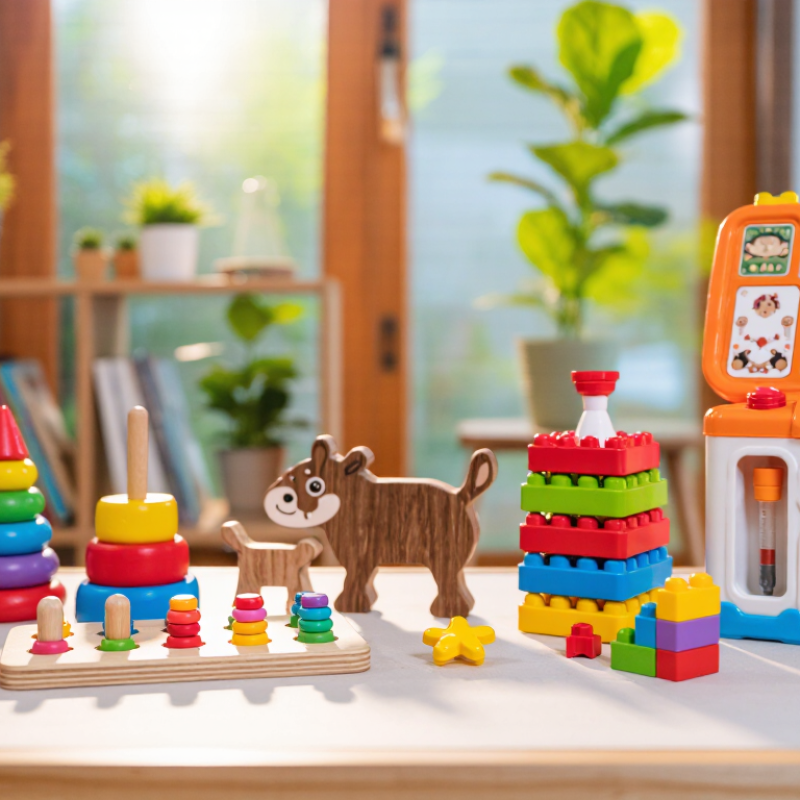
Educational toy selection works best when play matches a child’s current abilities, not just their birthday. For 0–6 months, choose soft books, high-contrast cards, and easy-grip rattles. These encourage visual tracking, reaching, and early communication. From 6–12 months, stacking cups and textured balls support grasping, releasing, and simple problem-solving. Children aged 1–2 years often benefit from shape sorters, large blocks, and push-pull toys.
Keep it simple. Between 2–3 years, pretend-play sets and chunky puzzles can strengthen language, memory, and hand control. From 3–5 years, open-ended construction pieces, drawing materials, and counting games invite creativity and early reasoning. Watch closely.
The CDC explains that its developmental milestones represent skills at least 75% of children can perform by a specific age. This makes age guidance useful, but not absolute. A child may ignore a “perfect” toy today and explore it next month.
The WHO 2019 guidelines recommend at least 180 minutes of physical activity daily for children aged 3–4, including 60 minutes of moderate-to-vigorous movement. Active toys should therefore include throwing, balancing, building, or moving.
The best choice also fits the child’s temperament, safety needs, and family interaction time. Adults can model one action, pause, and let the child experiment. Toy labels sometimes oversimplify development. Reflect, observe, and adjust.
Choose soft books, high-contrast cards, and easy-grip rattles. These support visual tracking, reaching, and early communication. Watch closely. Avoid toys with loose parts.
Stacking cups and textured balls encourage grasping, releasing, and simple problem-solving. Offer one or two items at a time. Babies may explore by dropping everything.
Large blocks and simple shape sorters support hand strength and coordination. Choose pieces too large to swallow. Smooth, sturdy edges matter.
Demonstrate one action, such as fitting a circle into an opening. Then pause and let the child experiment. Do not correct every mistake.
Around age one, children may bang pieces or place them randomly. By age two, many begin matching basic shapes with help. Near age three, some sort colors, name shapes, or build small structures.
Short sessions often work best. Five focused minutes may be enough. Stop when the child becomes tired or frustrated.
Offer fewer pieces or choose a larger, simpler set. Tight openings can discourage exploration. I sometimes expect progress too quickly. That needs reflection.
No. Age guidance is useful, but children develop at different speeds. Observe the child’s abilities, interests, temperament, and safety needs. Adjust later.
Choose toys involving throwing, balancing, building, or movement. Children aged three to four need plenty of daily activity. A small indoor obstacle course can help.
Stay nearby, especially with toddlers. Check for small pieces, sharp edges, and damaged parts. Even suitable toys require supervision. Mistakes happen.
Choosing educational toys according to a child’s developmental stage can make play more meaningful and effective. But what age are educational toys suitable for? The answer depends on the skills a child is ready to practice. For ages 1–3, building blocks and shape sorters encourage hand coordination, problem-solving, and early awareness of colors, forms, and balance. From ages 3–5, puzzles and pretend-play sets help children strengthen memory, language, imagination, and social skills through engaging activities.
For children ages 6–8, science kits and coding toys introduce basic concepts such as observation, sequencing, experimentation, and logical thinking in an accessible way. Between ages 9 and 12, strategy games and creative maker kits promote planning, patience, flexible thinking, and independent creativity. By matching toys with developmental abilities rather than choosing solely by appearance, parents and educators can support learning while keeping play enjoyable, challenging, and appropriate for each age group.

 Toym Toy