Choosing educational toys for children from China calls for more than comparing prices or colorful packaging. Parents and buyers should ask what a child can actually do with a toy: stack wooden blocks, sort shapes, test a simple balance, or invent a story with figures. A useful toy invites repeated play and leaves room for the child’s ideas. Labels such as “STEM” or “Montessori-inspired” are not proof of learning value.
Grand View Research’s Educational Toys Market report estimated the global market at USD 58.3 billion in 2023 and projected continued growth. That figure describes commercial demand, not a toy’s educational impact. Market forecasts measure sales, not learning outcomes. For a stronger developmental lens, consider the American Academy of Pediatrics’ clinical report on play. Its lead author, pediatrician Dr. Michael Yogman, wrote: “Play is not frivolous: it enhances brain structure and function, and promotes executive function.” His point is practical: meaningful play matters more than a fashionable label.
When evaluating products made in China, look closely at age guidance, materials, construction, and instructions. Check whether small pieces suit the child’s age, whether edges feel smooth, and whether parts stay secure during ordinary play. Ask suppliers for clear product specifications and relevant test documentation, then verify claims rather than relying on a polished product page. A toy may look excellent in a catalog and feel awkward in a child’s hands. That happens. The best choice fits the child’s current interests, abilities, and patience—and can still be used in more than one way. That is the heart of how to choose educational toys for children.
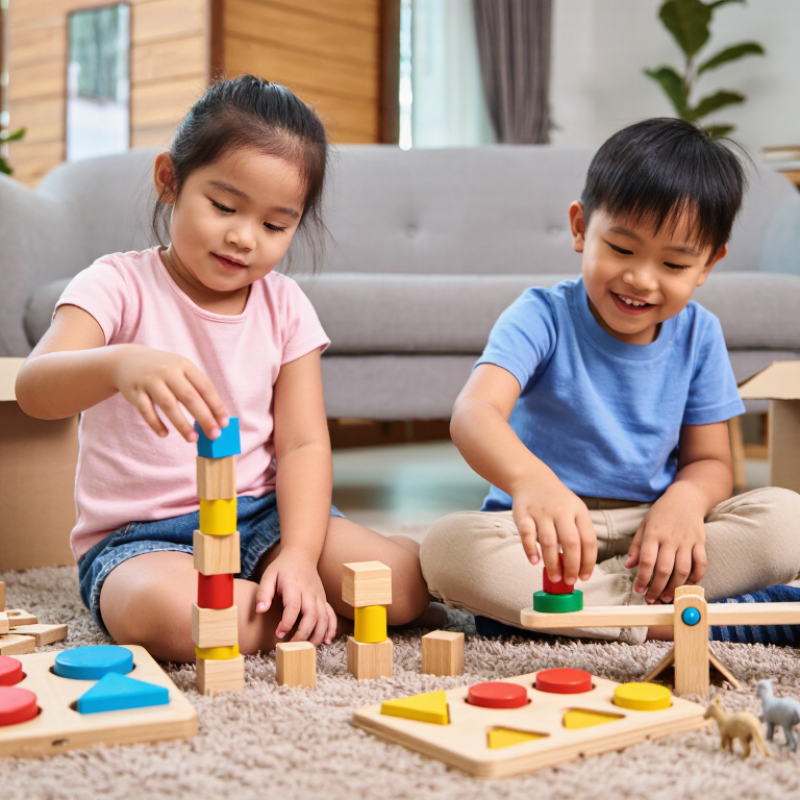
A child’s age is a useful starting point, not a complete buying guide. Check the age range and instructions provided for a toy made in China, then consider what the child can safely handle. A toddler may enjoy large, easy-to-grip pieces, while an older child may be ready for simple building challenges. Watch closely. If small parts, complicated steps, or unclear directions create frustration, the toy may not suit the child yet.
Interests matter just as much. A child who loves animals might sort toy figures by habitat, while a keen little builder may spend longer fitting blocks together. Look for ways to play that invite questions, choices, or repeated practice. A shape sorter can support matching; pretend kitchen pieces can prompt naming and sharing. Keep the child’s current abilities in mind, too. A puzzle that is slightly challenging can encourage persistence, but a puzzle that is far too hard may end up under the sofa.
Think about developmental needs without treating them like a checklist. Some children benefit from toys that encourage hand control; others may prefer movement, pretend play, or quiet exploration. Notice what holds attention at home, not only what looks educational in a product photo. Scale can be hard to judge online. Ask for clear dimensions and age guidance when details are missing. Even careful matching is imperfect: a promising toy may sit untouched, and that is useful information for the next choice.
Before choosing a toy, define one skill you want a child to practise. “Build problem-solving” is too broad. Try “match five shapes,” “count ten wooden pieces,” or “explain why a bridge falls.” Clear goals make play easier to observe. Small target.
Match the toy’s actions to the goal. A threading board can support hand control and patterning; pretend groceries can invite counting, sorting, and conversation. Check that the child can use it with modest effort, but still faces a small challenge. If adults must demonstrate every move, the learning goal may be too advanced—or the instructions may be unclear. I would reassess after a few play sessions; one observation can mislead.
Evidence can help set priorities. The American Academy of Pediatrics’ 2018 clinical report, “The Power of Play,” describes play as supporting language, early math, executive function, and social-emotional development. For context, the National Center for Education Statistics reported that 36% of U.S. fourth-graders reached at least Proficient in mathematics on the 2022 NAEP assessment. That figure is not proof that toys raise scores. It does underline why concrete counting and reasoning practice can matter. When comparing educational toys from China, ask suppliers for age guidance, material details, and clear examples of the skill each activity exercises. A polished label is not evidence of learning.
| Learning Goal | Suitable Toy Type | Skills Supported | Typical Age Range | What to Look For | Safety and Use Check |
|---|---|---|---|---|---|
| Early problem-solving | Shape sorters and simple puzzles | Matching, spatial reasoning, persistence, and hand-eye coordination | About 1–4 years, depending on complexity | Pieces should be easy to grasp at first, with a gradual increase in challenge. | For children under 3, avoid small parts that could present a choking hazard. Check the age guidance and inspect pieces regularly. |
| Fine-motor development | Large interlocking blocks, stacking cups, or lacing toys | Grasping, stacking, bilateral coordination, and controlled movement | About 1–6 years, with age-appropriate piece sizes | Choose durable pieces with edges that are smooth and comfortable for small hands. | Check for cracks, sharp edges, loose parts, and cords or strings that may pose a strangulation risk. |
| Language and communication | Picture cards, story cubes, and pretend-play sets | Vocabulary, listening, sequencing, storytelling, and turn-taking | About 2–7 years | Look for clear pictures and open-ended prompts that invite conversation rather than only one correct response. | If the toy includes printed text or audio, check that the language and content suit the child and intended learning goal. |
| Early numeracy and patterns | Counting counters, number puzzles, and pattern blocks | Counting, sorting, comparing quantities, and recognizing patterns | About 3–7 years | Choose activities that connect numbers with quantities and allow children to sort or build in different ways. | Confirm that pieces are appropriately sized for the child’s age and are not easily swallowed. |
| Scientific curiosity | Magnifiers, simple balance scales, and child-friendly experiment kits | Observation, prediction, comparison, and cause-and-effect reasoning | About 4–10 years, depending on the activity | Prefer reusable activities with clear instructions and materials that let children observe or test one idea at a time. | Review supervision requirements and included materials. Avoid kits with hazardous chemicals or unsuitable tools for the child’s age. |
| Creativity and self-expression | Washable art materials, modeling dough, or construction sets | Imagination, planning, visual expression, and flexible thinking | About 2–10 years, depending on materials and supervision | Choose materials that support more than one finished result and are suitable for the child’s dexterity. | Check age guidance, material information, and cleanup requirements. Supervise young children during use. |
Age ranges are general guides, not developmental assessments. Always follow the toy’s age labeling and safety instructions, and choose activities that match the child’s abilities and interests.
When choosing educational toys from China, check the material details before judging a toy by its finish. Ask for a bill of materials and recent test reports covering the specific model, age group, and production batch. For toys used by young children, check small parts, sharp edges, coatings, and accessible batteries. A smooth wooden block can still have a coating worth checking. Paperwork can look reassuring, but it must match the product in your hands.
Labels should show the intended age, relevant warnings, and traceable manufacturer or batch information. Then check the standards for the market where the toy will be sold. ASTM F963 is a key U.S. toy-safety standard; EN 71 applies in the European market, while ISO 8124 offers an international framework. Requirements differ by destination, so a certificate for one market may not cover another. The U.S. Consumer Product Safety Commission’s 2023 report estimated 231,700 toy-related emergency-department injuries that year. This is a reminder to check both design risks and test evidence, not just the label.
Tips: Match the report’s model number to the toy and verify the testing laboratory’s scope. Ask what changed if materials or suppliers differ. Small details matter. If a warning is vague, ask for clarification before buying.
A well-designed educational toy should make learning visible. Look for clear cause and effect: a wooden gear turns another gear, or colored counters fit into matching slots. Compare how many ways a child can use each piece, not just the number of features listed. Simple designs often invite more experimentation. Small parts, sharp edges, and loose attachments deserve close inspection, especially for younger children.
Durability shows up in the details. Check whether joints wobble, paint flakes, or fabric seams pull apart after repeated handling. Ask the supplier for material specifications and test reports, then inspect a sample yourself. I still find this step easy to rush. It matters.
The U.S. Consumer Product Safety Commission’s 2023 Toy-Related Deaths and Injuries report estimated 231,700 toy-related emergency-room injuries among children aged 14 and younger. That figure is not a measure of any one toy’s risk, but it supports careful checks of construction and age guidance.
Match pieces to the child’s abilities: chunky shapes for early grasping, and more complex rules for children ready to sort, count, or build. A toy that frustrates a child may be technically age-appropriate, yet poorly suited to that child.
When comparing Chinese suppliers, look beyond a polished catalog. Request a recent sample and check whether its colors, edges, and small parts match the listing. Ask for evidence. A useful supplier should explain production capacity, inspection steps, and how product changes are recorded. Verify that reports and product documents apply to the exact model you plan to buy, not just a similar item.
Product details matter in daily use. Check the recommended age, learning goal, material description, dimensions, and cleaning instructions. For a counting toy, test whether the numbers are easy to read and pieces fit comfortably in a child’s hand. Request clear photos of labels and packaging. If details seem vague, pause and ask specific questions. It is easy to mistake attractive packaging for sound educational design.
Agree on after-sales support before placing an order. Confirm how defects are reported, what evidence is needed, and whether replacement parts are available. Set a response-time expectation in writing, along with the process for damaged shipments or inconsistent batches. Keep messages, approved samples, and specifications together. A video call can clarify questions, but it does not replace written terms. No supplier is flawless, and I would still allow time for an imperfect sample or a delayed reply.
Use the age range as a starting point, not a complete guide. Check whether the child can grip the pieces and follow the steps. Watch them play.
Yes. Animal figures can invite sorting by habitat, while blocks may keep a young builder busy. A promising toy can still sit untouched.
Choose one clear skill, such as counting ten pieces or matching five shapes. A specific goal is easier to notice. Small target.
Watch whether the child can use it with modest effort. If an adult must show every move, the task may be too advanced or unclear. Reassess after a few play sessions.
Look for visible cause and effect, such as one wooden gear turning another. Pieces with several possible uses can encourage more exploration than a long feature list.
Inspect a sample for loose joints, flaking paint, and seams that pull apart. Ask for material details and test reports. I can rush this check, too.
Check for small parts, sharp edges, and loose attachments. Match piece size and play steps to the child’s abilities. Stay nearby during play.
Ask for clear dimensions, age guidance, and examples of the skills each activity supports. Product photos can make scale hard to judge. A polished label proves little.
Choosing educational toys for children from China starts with understanding the child’s age, interests, and developmental needs. Consider what the child enjoys and which abilities the toy could encourage, such as problem-solving, creativity, coordination, or early language skills. Clear learning goals make it easier to compare options and select a toy that is engaging as well as appropriate for the child’s stage of development.
When deciding how to choose educational toys for children, check the materials, safety labels, and applicable standards, and review the toy’s design, durability, and age-related features. Look for clear product details, including dimensions, recommended age, and care instructions. When comparing Chinese suppliers, assess how thoroughly they answer questions, communicate product specifications, and handle after-sales support. A thoughtful evaluation of both the toy and its supplier can help you make a more informed choice.
