Educational toys are moving beyond colorful shapes and simple number cards. Global buyers now examine how a product supports curiosity, problem-solving, language, and social development. Grand View Research estimates that the global educational toys market reached approximately USD 57 billion in 2023. Its report also projects strong growth through 2030. These figures suggest opportunity, but forecasts are not promises. Consumer budgets, birth rates, safety standards, and local learning habits can change quickly.
So, what is the future of educational toy development? The answer is not limited to adding screens or artificial intelligence. UNESCO’s Global Education Monitoring Report 2023 warns that technology improves learning only when it serves clear educational goals. This matters for buyers choosing coding kits, sensory toys, robotics sets, and hybrid learning products. A tablet-linked toy may look advanced, yet poor design can distract children within minutes. Sometimes, a wooden puzzle teaches more effectively.
The following trends focus on practical value, measurable skills, inclusive design, and responsible innovation. The Toy Association’s recent trend reporting highlights STEM play, sensory experiences, creativity, and products supporting children’s emotional wellbeing. Meanwhile, OECD research continues to emphasize active learning, collaboration, and learner agency. These findings help connect market demand with real classroom and household experience. Still, the industry has unresolved questions. Are smart toys protecting privacy clearly? Can sustainable materials survive daily handling? Will global buyers accept higher prices for repairable products? The next ten trends explore these opportunities, while recognizing that educational claims need evidence, testing, and continuous review.
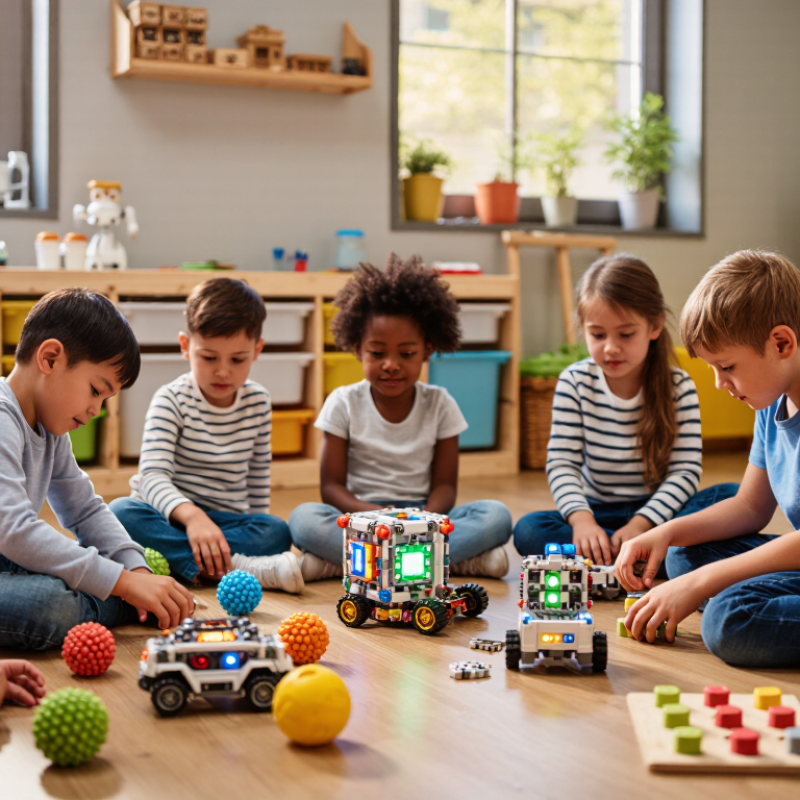
The global educational toy market is forecast to grow at a 10.5% CAGR from 2024 to 2030, according to Grand View Research. This figure gives buyers a useful planning baseline, not a guaranteed result. Demand is shifting toward toys that combine learning, play, and measurable progress.
Ten trends deserve attention: STEM kits, early coding, robotics, language tools, sensory play, inclusive design, eco-conscious materials, adaptive learning, physical-digital hybrids, and build-your-own activity sets. A six-year-old may assemble a simple circuit, hear feedback, and correct a mistake without adult intervention. That small moment can create stronger learning value than bright packaging. Digital features should remain optional. Screens can support play, but they should not replace touch, movement, or conversation.
Global buyers should test durability, age suitability, instructions, and educational claims before placing large orders. A prototype may survive a showroom demonstration but fail after repeated drops on a classroom floor. It happens. Packaging must also handle different languages and cultural expectations. Local educators can reveal problems that laboratory testing misses. Buyers should request material documentation, safety testing, and evidence behind developmental claims. Forecasts can change with household budgets, shipping costs, and policy requirements. The 10.5% projection is encouraging, yet cautious purchasing remains wiser than chasing every fashionable feature.
The U.S. Bureau of Labor Statistics projects STEM employment to grow 10.8% from 2021 to 2031, faster than overall employment at 5.3%. This signal matters for global educational toy buyers. Children need early practice with sequencing, logic, testing, and problem-solving. Coding toys can turn these skills into visible actions: a card sequence moves a small vehicle, or a sensor changes a lamp’s color. Simple feedback keeps abstract ideas tangible.
The World Economic Forum’s Future of Jobs Report 2023 states that 44% of workers’ skills may be disrupted within five years. Toy suppliers should therefore assess open-ended play, not only colorful packaging. Products with adjustable difficulty, visual coding blocks, and offline challenges can support different learning levels. Language-free symbols also improve international usability. Small details matter.
Not every coding toy teaches coding. Some only reward button pressing. Buyers should request age testing, safety documentation, repair guidance, and evidence from classroom trials. I would also question overly precise learning claims; play outcomes vary by adult support, culture, and access. A strong product leaves room for mistakes, because children learn by changing one instruction and watching the result. That part remains easy to overlook.
HolonIQ projected global education-technology spending would reach $404 billion in 2025. That figure is a forecast, not a count of educational toy sales. For global buyers, it signals growing investment in digital learning, while leaving room to question whether every connected toy improves learning. AI can adjust a puzzle’s difficulty after a child’s repeated attempts. Adaptive play can offer a simpler hint rather than give away the answer. AR can place a three-dimensional solar system above a kitchen table. Small details matter: clear instructions, sturdy parts, and play that still works when Wi-Fi fails.
The evidence calls for measured claims. UNESCO’s 2023 Global Education Monitoring Report says technology’s learning impact depends on how it is used, and robust evidence remains uneven. That is a useful test for AI and AR toys. Does the toy invite a child to explain, build, or experiment, or mostly keep them tapping? OECD’s PISA 2022 results also found that about 30% of students across OECD countries reported distraction from digital devices in most or every mathematics lesson. Buyers should examine privacy safeguards, age suitability, and independent learning evaluations alongside novelty. A polished demo is not proof. Even a clever toy can miss the mark.
Forecast context: The $404 billion figure is a pre-2025 forecast for global education technology expenditure, not a verified result and not a forecast for educational toys alone. The trends below are buyer-facing opportunities; they do not imply guaranteed sales or market shares.
| No. | Trend | What Is Changing | Evidence-Based Buyer Considerations | Practical Evaluation Criteria |
|---|---|---|---|---|
| 1 | AI-guided play | Conversational features and automated hints can make play feel more responsive, but generative AI is not necessary for every learning activity. | UNESCO advises that educational use of generative AI should be human-centred and designed with privacy, age suitability, and learner wellbeing in mind. | Check whether responses are age-appropriate, bounded to the activity, understandable to caregivers, and usable without collecting unnecessary personal data. |
| 2 | Adaptive difficulty | Activities can adjust prompts or challenge levels in response to a child’s progress, using either simple rules or more complex algorithms. | Adaptive features should support practice rather than label a child’s ability. A clear explanation of what is tracked helps buyers assess privacy and educational value. | Test whether difficulty changes are transparent, reversible, and helpful for children who learn at different paces; request evidence from age-appropriate user testing. |
| 3 | Augmented-reality play | Camera-enabled experiences can add digital objects or guidance to physical toys, connecting screen-based content with hands-on activities. | AR usefulness depends on device compatibility, lighting, tracking reliability, and whether the digital layer adds learning value beyond the physical toy. | Check supported devices, accessibility, offline or low-connectivity options, camera permissions, and whether the core activity remains usable without AR. |
| 4 | Screen-light and screen-optional design | Buyers are assessing digital features alongside the quality of physical, imaginative, and social play—not treating more screen time as an automatic benefit. | The World Health Organization advises no sedentary screen time for infants under 1 year and no more than 1 hour per day for children aged 2–4; less is better. This is daily guidance, not a toy-specific limit. | Prefer products with meaningful hands-on play, short and purposeful digital sessions, and clear caregiver controls. |
| 5 | Connected physical-digital kits | Physical pieces paired with apps or digital guides can support building, coding, storytelling, or experimentation across multiple play modes. | The experience may depend on software updates, device access, and an internet connection, creating ongoing support and compatibility considerations. | Ask about app availability periods, update policies, supported operating systems, replacement parts, and what happens if online services are unavailable. |
| 6 | Early coding and computational thinking | Unplugged sequencing, physical coding pieces, and beginner robotics can introduce patterns, instructions, and problem-solving through play. | Learning value is stronger when children can experiment, predict outcomes, and debug—not simply follow a fixed sequence of instructions. | Review the progression of activities, opportunities for open-ended solutions, adult support needs, and the age range tested. |
| 7 | Multilingual and locally adaptable content | Global buyers need content that works across languages, reading levels, cultural contexts, and classroom or home settings. | Direct translation may not preserve meaning, pronunciation, examples, or age suitability. Local review is important for both language and context. | Check language quality with local reviewers, audio and text options, regional curriculum fit, and whether content can be updated without replacing the product. |
| 8 | Inclusive and accessible play | Products are increasingly evaluated for usability by children with different sensory, motor, communication, and learning needs. | Digital companion content can be reviewed against accessibility guidance such as WCAG 2.2, while physical play features need separate usability testing. | Assess readable instructions, adjustable audio and visual settings, tactile or alternative interaction options, and testing with a diverse group of children. |
| 9 | Privacy-first connected toys | Microphones, cameras, profiles, and learning analytics can create privacy risks if data collection and retention are not limited and clearly explained. | In the United States, COPPA covers online collection of personal information from children under 13. In the European Union, the GDPR’s parental-consent age for certain online services varies by member state from 13 to 16. | Review data collected, purpose, retention, deletion options, parental controls, security practices, and compliance requirements in each target market. |
| 10 | Durable, repairable, and safety-conscious design | Buyers are weighing product lifespan, replacement components, battery handling, packaging, and applicable toy-safety requirements alongside learning features. | Toy-safety rules differ by destination market. Relevant frameworks include the European toy-safety requirements, U.S. toy safety rules, and ISO 8124; applicability depends on product and market. | Request market-specific compliance documentation, age-grading rationale, durability and small-parts testing, repair or spare-parts information, and clear battery guidance. |
Source notes
HolonIQ, pre-2025 global education technology expenditure forecast: forecast context. The figure is presented here as a historical forecast, not as a confirmed actual result.
World Health Organization, Guidelines on Physical Activity, Sedentary Behaviour and Sleep for Children Under 5 Years of Age.
UNESCO, Guidance for Generative AI in Education and Research.
U.S. Federal Trade Commission, Children’s Online Privacy Protection Rule; European Commission, data protection information for individuals.
World Wide Web Consortium, Web Content Accessibility Guidelines (WCAG) 2.2.
Eco-design is becoming a practical buying requirement, not a decorative feature. NIQ reports that 73% of consumers show concern about sustainability, creating pressure for educational toy suppliers worldwide. Buyers now examine materials, packaging, durability, and end-of-life options before placing large orders.
A stronger toy design uses fewer mixed materials. Recycled plastic, responsibly sourced wood, and water-based finishes can reduce environmental impact. Modular parts also support repair instead of replacement. A loose wheel should not make an entire learning kit useless. Packaging matters too. Compact paper packaging can reduce shipping volume and unnecessary waste. However, recycled materials are not automatically better. Their origin, safety testing, durability, and processing methods need clear evidence.
Tips: Ask suppliers for material specifications, test reports, packaging measurements, and lifecycle information. Prefer replaceable components and simple disassembly. Check whether sustainability claims are verified independently. Small changes help, but they need consistent documentation.
Circularity remains difficult in practice. Collection systems differ across countries, and some educational toys contain materials that are hard to separate. Buyers should avoid vague promises and request measurable targets. A repair guide, spare-part plan, or take-back process can show real commitment. We may still overestimate how easily children’s products return to production. That weakness deserves honest review.
Educational toys are becoming more connected, adaptive, and data-aware. Compliance must develop with them. For physical products, ASTM F963 and EN 71 testing should cover materials, flammability, migration, sharp points, and small parts. Test early. A loose button, exposed wire, or unclear age label can delay shipment and harm trust.
Digital features require stronger safeguards. COPPA obligations may apply when a service collects personal information from children under 13 in the United States. GDPR-K requirements can involve lawful processing, parental consent, data minimization, and child-friendly privacy notices in Europe. Design dashboards with simple consent screens. Store only necessary data. Delete voice recordings and profiles when retention is no longer justified. Keep evidence.
Global buyers should request laboratory reports, technical files, risk assessments, software update records, and supplier declarations. They should also check whether product instructions match each destination’s language and age guidance. Compliance is not a single certificate. It is a continuing process involving design, manufacturing, testing, and after-sales support.
In practice, teams may miss a privacy setting after a software update. That weakness deserves honest review. A quarterly audit, access log, and documented correction plan can reduce the risk. Independent testing adds confidence, but internal accountability still matters. Safe innovation begins with traceable decisions, not attractive features alone.
They make sequencing and logic visible. A child can arrange cards, then watch a small vehicle follow the route. Simple feedback helps.
Children can test instructions, solve problems, and adjust their plans. Changing one card can change the vehicle’s path. Small experiments count.
No. Some toys reward button pressing without teaching sequencing or testing. Ask for classroom trial evidence, not just bright packaging.
Adjustable difficulty, visual coding blocks, and offline challenges can support varied learning needs. Language-free symbols may help, too. Not always perfectly.
Request age testing, safety reports, repair guidance, and clear instructions. Check small parts, wires, materials, and age labels closely.
Collect only necessary data, explain privacy choices clearly, and limit access. Delete recordings and profiles when retention is no longer justified. Review settings.
Recheck privacy settings and keep update records. A missed setting can weaken protections. A quarterly review is useful, though easy to forget.
U.S. STEM employment was projected to grow 10.8% from 2021 to 2031. That suggests demand for practice, not guaranteed learning outcomes. Play varies.
The future of educational toy development is being shaped by strong market growth, advancing technology, and changing buyer expectations. With the sector projected to expand at a 10.5% CAGR from 2024 to 2030, global buyers are prioritizing toys that build practical skills through STEM activities, coding, engineering challenges, and creative problem-solving. This direction also reflects the expected growth of STEM-related employment, creating demand for products that make learning more engaging and accessible from an early age.
Future-ready toys will increasingly combine artificial intelligence, augmented reality, and adaptive play to personalize challenges while supporting safe, age-appropriate learning. Sustainable materials, durable construction, repairability, and circular design will become essential as consumers show greater concern for environmental responsibility. At the same time, manufacturers and buyers must treat global compliance as a core requirement by addressing toy safety, children’s privacy, data protection, clear labeling, and responsible digital features. Together, these trends point toward educational toys that are intelligent, inclusive, sustainable, secure, and valuable across international markets.
