Walk into a modern nursery, and you may see wooden trays, nesting blocks, stacking rings, and textured puzzles made in China. These toys often use calm colors, simple shapes, and child-sized designs. They look purposeful rather than flashy. Parents increasingly value play materials that encourage concentration, coordination, and independent choice. So, why are montessori toys becoming popular? The answer involves more than appearance. Families are seeking screen-free activities that fit naturally into everyday routines.
China has developed extensive toy manufacturing experience, supported by skilled workshops, material suppliers, and large-scale production. This infrastructure can make Montessori-inspired toys more accessible and affordable. A carefully sanded wooden cylinder, for example, can give a child a clear grasping challenge without unnecessary features. Online retailers also provide detailed photos, age guidance, and customer feedback. These tools help parents compare products before purchasing. Still, low prices alone do not prove good quality.
Quality can vary widely. That matters. Responsible manufacturers should control paint, wood treatment, edge finishing, and small-part risks. Buyers should check independent testing, safety documentation, and transparent material descriptions. Familiar labels may create confidence, but they are not perfect evidence. Some products use “Montessori” as a marketing term without following thoughtful educational principles. This is where professional judgment becomes important. A useful toy should match the child’s age, ability, and real interests, not merely copy a popular design. As manufacturing improves, trust will depend on honest claims, consistent testing, and closer attention to how children actually use these objects.
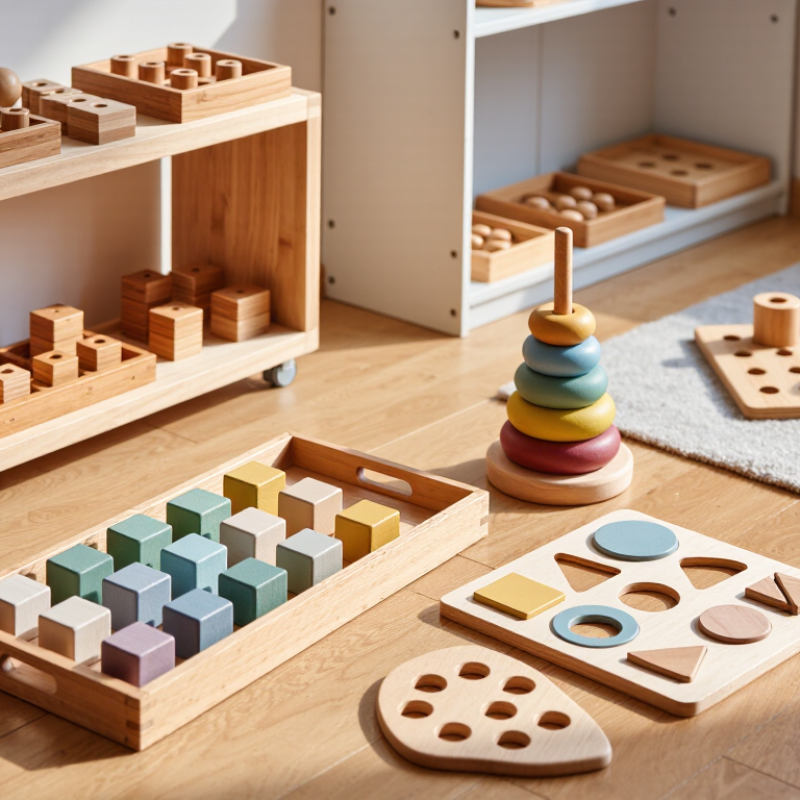
Montessori toys are learning tools designed to support independent discovery. They usually have one clear purpose, such as sorting shapes, transferring water, or practicing buttons. Their design is simple, not flashy. Children can touch, repeat, adjust, and try again without constant adult correction. Natural textures, manageable sizes, and realistic details often make the activity feel meaningful. A wooden tray, small pitcher, and cotton cloth can turn pouring into focused practice.
The core feature is purposeful movement. A child may carry objects, match colors, build patterns, or solve a small problem. Many materials include control of error, allowing children to notice mistakes themselves. This supports concentration and confidence. Educators also value open-ended use, because one object can encourage several levels of exploration. However, not every plain wooden toy is truly Montessori. The label can be used too loosely.
Toys made in China are becoming popular because manufacturers can offer flexible designs, efficient production, and accessible prices. Many factories also provide different wood finishes, packaging options, and small production adjustments. These advantages help educators and families find practical materials for home or classroom use. Still, quality is not automatic. Buyers should check material safety, smooth edges, paint information, durability, and age suitability. A beautiful toy may still frustrate a child if the grip is too large or the task is unclear. The best choice comes from observing the child, not following a trend.
China’s role in Montessori toy manufacturing has grown through a practical combination of skilled labor, material access, and flexible production. Many workshops can shape wood, smooth edges, and apply water-based finishes at different production scales. This flexibility helps manufacturers create stacking blocks, sorting trays, and sensory boards for varied classroom needs.
In practice, reliable production depends on more than low prices. Responsible factories check wood moisture, surface smoothness, paint adhesion, and small-part safety. They also keep records for material sourcing and batch inspections. These steps support safer products and more consistent learning experiences. A well-made wooden puzzle should feel solid in a child’s hands, with pieces that fit without force.
China also supports detailed customization. Educators can request specific dimensions, colors, textures, or packaging for different age groups. However, customization can create problems when speed replaces careful testing. A bright finish may look attractive but distract from the child’s task. A clever shape may also be difficult for small hands to grasp. These details require professional review, not only factory approval.
Manufacturing quality still varies between suppliers. Buyers should examine samples, request safety documentation, and evaluate communication before placing large orders. Clear specifications reduce misunderstandings about wood types, coating standards, and tolerances. The strongest producers treat Montessori design as an educational responsibility, not simply a manufacturing category.
Montessori toys made in China are becoming more visible in homes, classrooms, and online shops. One reason is affordability. Large-scale manufacturing can reduce costs without automatically reducing usefulness. Families may buy wooden puzzles, stacking blocks, and practical-life tools at prices that fit a limited budget. This wider access matters when parents want hands-on learning materials instead of colorful electronic toys.
Design variety also drives interest. Chinese factories can produce many shapes, textures, and sizes for different age groups. A small knob puzzle may strengthen finger control. Smooth counting beads can support early number recognition. Some producers now provide clearer age guidance, material details, and safety testing information. Buyers can compare those details before ordering. Reviews showing chipped paint, rough edges, or strong odors remain useful warnings. A low price is not proof of good value.
Quality is still uneven. This deserves attention. Montessori education emphasizes purposeful movement, independence, and real-world skills. A toy with attractive wood may not support those aims. Parents should check whether pieces are durable, easy to clean, and appropriately challenging. They should also look for compliance information relevant to their region. In my view, popularity comes from convenience, choice, and improving production knowledge. However, the label “Montessori” can be used too loosely. Careful selection remains necessary, especially when product descriptions sound better than the actual materials.
Montessori toys made in China are gaining attention because they can combine accessible prices with carefully designed learning features. Quality, however, depends on materials, workmanship, and inspection rather than country of origin alone. A smooth wooden puzzle should have clean edges, secure pieces, and a finish without strong chemical odors. Small parts also require age-appropriate supervision. In real classroom settings, children often learn more from simple objects than noisy electronic toys. Yet, some products look educational without supporting meaningful concentration. That difference deserves careful thought.
Safety should be checked through clear product information, testing records, and reliable age guidance. Responsible sellers should explain the material, coating, cleaning method, and manufacturing controls. Parents can examine hinges, cords, magnets, and detachable parts before use. I have found that practical inspection catches problems that attractive photographs hide. It is not perfect. Packaging claims can still be vague, and educational labels may be used too freely. A toy should encourage hands-on movement, choice, repetition, and independent problem-solving. It should not replace conversation or patient adult guidance.
Tips: Choose solid, smooth materials and avoid sharp edges. Match the toy with the child’s developmental stage. Watch how the child uses it, not just how it looks. Check for loose pieces after play. Rotate fewer toys at a time. If a toy causes frustration, pause and reconsider its difficulty, purpose, and design.
Montessori toys made in China are gaining attention because manufacturers can offer varied materials, precise cutting, and flexible production. Grand View Research estimated the global educational toys market at about US$61.77 billion in 2023. This growth increases choice, but it also demands careful selection. Manufacturing location alone does not prove safety or educational value.
Choose the toy’s purpose before its appearance. A suitable product should match the child’s age, hand strength, attention span, and developmental stage. Look for smooth edges, secure parts, non-toxic finishes, and clear material specifications. Ask suppliers for current testing documents, batch traceability, and quality-control records. Depending on the destination market, relevant standards may include EN 71, ASTM F963, or applicable consumer-safety rules. These documents should identify the exact product, not a similar sample. I once assumed a heavier wooden toy was more durable. That was not always true; poor coating can still crack around the corners.
Tips: Observe the child using the toy. Can they lift, sort, match, or repeat the activity independently? Avoid toys with excessive lights and sounds when the goal is concentration. Check every fastener and painted surface by hand. A low price may reflect efficient production, but it may also hide thinner materials or weaker inspection. Request a pre-production sample, then compare it with the mass-produced batch. Small differences matter.
Chinese manufacturers are increasingly attractive because they can offer flexible production, varied materials, customization, and competitive pricing. However, buyers should evaluate safety and quality before choosing a supplier.
How to Choose Suitable Montessori Toys Made in China
The chart presents a practical buyer-priority score based on major requirements covered by international toy-safety frameworks, including EN 71, ASTM F963, ISO 8124, and CPSIA. Safety documentation, age suitability, material quality, and supplier traceability should be checked before price and customization.
China offers skilled labor, accessible materials, and flexible production. Workshops can shape wood, smooth edges, and apply water-based finishes. This supports blocks, sorting trays, puzzles, and sensory boards. Not every supplier performs equally.
No. Safety depends on materials, workmanship, testing, and inspection. Check smooth surfaces, secure pieces, suitable sizes, and clear age guidance. Inspect hinges, cords, magnets, and detachable parts before use. Look closely.
Buyers should ask about wood type, moisture levels, coatings, and surface treatment. The wood should feel solid and smooth in a child’s hands. Finishes should not create strong chemical odors. Packaging information may remain vague.
Request physical samples, safety documents, material records, and batch inspection details. Review communication before placing a large order. Clear specifications reduce mistakes about dimensions, coatings, and tolerances. Photos are not enough.
Yes, manufacturers can adjust dimensions, colors, textures, and packaging. Customization may suit different ages or classroom activities. However, attractive colors can distract children from the learning task. A clever shape may be difficult to grasp.
A useful toy encourages movement, choice, repetition, and independent problem-solving. Simple wooden objects can support concentration without electronic noise. The toy should match the child’s developmental stage. Labels alone prove little.
Yes, especially when toys include small or detachable parts. Adults should watch how the child uses the toy, not only its appearance. Patient guidance supports learning, but adults should avoid solving every problem. That balance is difficult.
Pause and reconsider its difficulty, purpose, and design. Check whether the child can grasp, separate, or understand each piece. Remove loose parts after play. Sometimes the toy is the problem.
Montessori toys are designed to encourage independent learning, hands-on exploration, concentration, and the development of practical skills. Their simple designs, natural textures, open-ended functions, and child-centered approach allow children to learn through play rather than relying on electronic stimulation. China has become an important manufacturing center for these toys because of its efficient production systems, broad material supply chains, skilled workforce, and ability to offer diverse designs at competitive prices.
These factors help explain why are montessori toys becoming popular among parents, educators, and childcare providers worldwide. However, affordability should not replace quality or safety. Buyers should carefully check material standards, surface finishing, durability, age suitability, small-part risks, and educational value before making a purchase. Suitable Montessori toys made in China should be thoughtfully designed, safe for children, easy to use, and matched to the child’s developmental stage. When selected responsibly, they can support creativity, coordination, problem-solving, independence, and meaningful early learning.
